
So, about informing our students on proficiency.
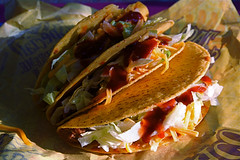
One of the great ideas that came from that PD I went to was this ‘taco’ activity. It’s designed to be done in the first days of school, preferable on the first day unless your first day is taken up with ‘administrivia.’
Divide students into four groups, or tell them to divide themselves into four groups.
Tell students that you want them to tell you what a taco is, in English. You can choose any other common object or activity, such as the circus.
For the first group, tell them that they can only use individual words to talk about the taco.
In the second group, they can use phrases.
In the third group, they can use simple sentences.
In the fourth, they can use descriptive language in compound sentences joined by transition words like ‘next’ and ‘also.’
When students use their ‘proficiency level’ to describe the taco, assign the proficiency labels to what they have done. Talk about which description gives the best idea of what the object/activity really is and why that level should be a goal. We also discussed having students write on large chart paper their descriptions, so that you can put them up on the wall. Then you can post on the chart ‘novice low’ and ‘approaches expectations’ and ‘C’ or whatever your assessment feedback language will be, and the students can have a visual reminder all semester or year of what exactly your expectations are.
Several teachers mentioned that this activity gives students a real idea of how accessible language is and gives everyone in the room a realistic view of where they could be at the end of the level. For the group of teachers I was with, their expectation is Novice High at the end of level 1 and Intermediate Low at the end of level 2 (they haven’t done level 3 yet).
I thought this was a great way for students to be introduced to proficiency levels and get away from the vague ‘here’s a list of units we may or may not finish this year’-type goals I’ve done before. What do you think?
Photo credit: Steven de Polo





20 Comments
Comments are closed.
Wonderful idea!! Love the way it shows kids that even without being fluent, they can still communicate. The idea that lack of 'fluency' equals no ability at all is so prevelant in my kids and I am constantly fighting to get them to use what they know 🙂 One question – is this lesson done all in English? Part English part Spanish? Seems like a worthwhile use of English but I wasn't sure how you were planning to do it seeing as the explanation would be tough for lower levels in TL. Thanks!
[…] It’s important to talk to kids about proficiency levels. This is a blog post I wrote about it: http://musicuentos.com/2011/06/proficiency-tacos/ […]
[…] inclusion as it is something they are familiar with. Holding an informational exercise a la “proficiency tacos” (@Musicuentos) is also in the works — perfect way to explain proficiency to students […]
[…] Proficiency & tacos. Share this:ShareFacebookTwitterEmailPrintLike this:LikeBe the first to like this. This entry was […]
WOW! it’s as easy as making a ‘taco’! your idea is phenomenal! thank you for sharing it with us. i will use this year as i am one of ‘those’ who likes to try new things all the time. using the sts native language (english) is most logical since the goal is not to assess their proficiency level but for them to understand how i will assess it. most important, as was stated before, is for sts to see that L2 acquisition is a life time process and well worth the time and effort put in to achieve the goal. i know this will be one of my best years…27th!
This is brilliant! Thanks for the tip.
[…] Explaining proficiency levels to kids […]
I am so intrigued with this amazing idea and am trying to envision it in my classroom. As I anticipate student reaction, I am wondering…will the kids think “Oh! If I’m writing single words that isn’t so great, but if I’m writing sentences, then I am doing really well.” When actually in the TPRS classroom, students are writing sentences right from the beginning. Many structures function as entire sentences. Could this cause any confusion? Or how would YOU handle that question from a student?
[…] more on illustrating proficiency, check out a very popular idea I stole for illustrating proficiency in the first days of […]
What a great idea…I’m always at a loss at what to do the first days of school…but this is perfect, especially since I want to introduce the proficiency levels. Thanks for sharing again. Hope all is well with you and your growing family!
You mention speaking in …
1. individual words
2. phrases
3. simple sentences
4. descriptive language with compound sentences and transition words
By individual words, I am assuming you mean … ‘crunchy, lettuce, shell, tomatoes, etc…’
What would we be the difference between a phrase and a simple sentence in this activity? Could you give me an ejemplo? Thanks
dseibel@warren.k12.in.us
Yes, you’ve got it right on individual words. By phrases I mean using connective devices – “meat with cheese” “lettuce but no tomato” “buy at restaurant” “sour cream on top.” Simple sentences would include complete thoughts but no complexity: “I like tacos with sour cream.” “I put meat first.” “Tacos are gross.”
Here’s a link to the free powerpoint from that PD to help you explain it to the students.
http://www.teacherspayteachers.com/Product/Powerpoint-and-Activities-to-explain-a-Proficiency-based-Classroom-298307
Love walking students through this process!
THIS. IS. BRILLIANT!! I’ve been teaching Spanish and French at the middle school level for 27 years. Two weeks ago a friend “Pinned” something about TPRS and TCI to her Education board and I went berserk!! Two weeks later and two weeks from the start of school, I’m planning on COMPLETELY upending everything I’ve ever done in order to start Day 1 in 90% TL using TCI. I’m excited and super nervous however, as a veteran teacher who still gets butterflies and actually gets excited on the first day of school, I’m super pysched! Thanks to all of you veteran TPRS/TCI teachers out there who selflessly post, blog, and share your experiences, ideas, and plans with this phenomenal methodology. As I write, I’m sitting in my blank classroom, wondering where everything is going to go. THIS will be my very first activity (after roll call, of course!). Thank you, Merci Beaucoup, and Muchisimas Gracias for this lovely post!!
Great! Let me know what I / we can do to help, and best of luck – it’s a great journey!
I’d love to REDO the way I teach using TPRS and TCI but have NO IDEA how!!!!! Help!
Joni, try looking through my posts tagged TPRS and you’ll get a good idea of how I implement that method and other ways of incorporating comprehensible input. You can also check out the TPRS 101 series that Martina Bex is doing. I hope these help you!
Thank you for this idea! I love it and will be using it on the second day of school this year!
[…] How to explain proficiency with tacos […]
[…] 9. Proficiency & tacos […]