• Home
  • Resources
  • Work with SEC
  • About SEC
  • Home
  • Resources
  • Work with SEC
  • About SEC
Personal development

Crowdsourced tips: Toward a new, improved conference model

Sara-Elizabeth Cottrell September 12, 2018 7 Comments

Sara-Elizabeth Cottrell ◆ Language Acquisition Specialist

Empowering teachers to boost children’s language acquisition process using high-leverage practices in everyday lessons, especially for Spanish and English language learners (ESL).

Crowdsourced tips: Toward a new, improved conference model
Sara-Elizabeth Cottrell September 12, 2018
  • Facebook
  • Twitter
  • LinkedIn
  • Tumblr
  • Google +
  • Pinterest
  • Email

I could be wrong, but it seems to me that teacher conferences are in trouble, and have been for a while.  As I looked ahead to rejoining the conference scene, earlier this year I asked the language teacher community on Twitter to think with me about problems and solutions with conferences.  I hope what we came up with is helpful as I try to distill and organize it in this post (which gives me a lot more empathy for those who have been involved in writing the #langchat summaries for years).

Before I launch into the problems and benefits related to conferences, let’s contemplate the question of blame for a minute.

Is it the hotels’ fault?

Don't get me started on conference hotel fees.
Don’t get me started on conference hotel fees.

First, hotels that put on conventions and conferences most often do so for people in the private sector.  Humana can afford to pay astronomical fees to send an employee to a conference.  So can home health firms, security firms, marketing firms.  Tattoo artists will pay it- it’s a business expense.  Magicians will pay it – it’s a business expense.  So the hotel has their own bottom line in mind, of course.  Want to use the internet in your session?  You’ll need to pay for that.  The projector, too.

At the hotel where I will present for a conference this year, I actually have to pay for the screen.  PAY FOR THE SCREEN.  Dear ridiculous Hilton hotel, I can bring my own projector, but what am I supposed to do without a screen?

(Maybe a tech boycott wouldn’t be so bad, though.  Cristina (@CristinaZimmer4) mentioned she’d “be interested to see a conference with no AV provided.”  She claims @ToddWhitaker was the best presenter she’s seen at a conference and he presented with almost no technology.)

In this high-tech world, though, consider that at many downtown conference hotels, the wifi isn’t included in your room.  And of course, you need to support their restaurant or room service, so neither is breakfast.  You can get free wifi and coffee and pastries at a random Red Roof, but don’t expect any of that at the downtown Sheraton.  (Just to give you some sticker shock, the average nightly rate at a Boston hotel is $254/night plus 14.5% in taxes at least.  Dear ACTFL, let’s stay out of Boston, pretty please.)

Here’s another catch you may not know, unless you’ve stopped to ask why the organization keeps emailing you about staying at the conference hotel: if the organization does not actually book a certain number of rooms, they owe a fine so large someone recently referred to it as “compromising our organization.”

Let me put that another way:

Conference hotels are willing to threaten the existence of volunteer-based teacher organizations in order to maintain the same profit margin they expect from private-sector, for profit companies.

So, here’s my first brainstorming question.

What if a convention/conference hotel chain dared to offer significant concessions to educational conferences because of who we are?  Because we’re training the future marketing firm professionals who will pay all their exorbitant costs?

Is it the district’s fault?

I get it, it's a lot of paperwork, a lot of decisions, a lot of bills. But is there nothing the district/admins can do?
I get it, it’s a lot of paperwork, a lot of decisions, a lot of bills. But is there nothing the district/admins can do?

Let me soapbox just a little more, this time on the institution side.

When I first moved to my city and started teaching, the private school had an incredibly supportive administration.  They gave every teacher PD time, even if it was to sit at home and read a professional book (because when do we have time for that?).  Not only did I have no trouble getting conference days off, as long as I wasn’t requesting a ton of them (maybe 2-3 a year), they funded my way to my first state conference here.  The head of school looked at me like he’d never been asked.  “Sounds like a really good idea,” he said.  And it was.  I was still a newbie, only my third year teaching, and joining my state organization quite drastically changed me as a teacher and a person.  That’s where I discovered storytelling, for one thing.

Fast forward a few years and you know the story: new leadership, new policies.  The changes were regular and significant.  My little world language department was eliminated and brought under the umbrella of Humanities (which also eliminated my department head stipend).  Leadership lamented the lack of a Scantron machine in the school and got annoyed that I didn’t know where the textbooks (we weren’t using) were.  And all thought of conference funding was gone.

Dear district and school leadership,

what message is it to tell your teachers you want them to know and implement all the latest improvements but by the way, pay for all that yourself?  And shockingly often, pay for your own substitute?

Here’s my next brainstorming question.

What if principals and district leadership put as much effort into quality professional experiences and connections for their teachers as they do into learning management software and busing schedules?

Or, to bring it to a question that hits me almost every time I drive under the overpass to leave my neighborhood:

What if state government put as much funding into supporting teacher PD as they did into the crazy expensive sound barriers that protect my privileged little ears from the highway traffic?

Okay, let me get off those soapboxes and get back to our group conversation.
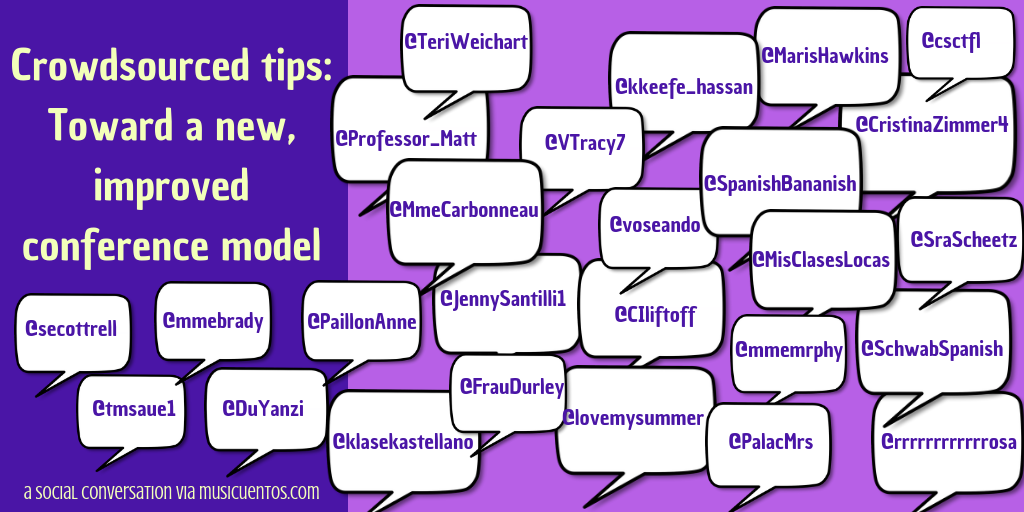
Crowdsourced tips_Toward a new, improved conference model

More of this at conferences, please

Several months ago, I asked a couple of questions on Twitter.  The first was to try to identify what it was that teachers love so much about going to a conference.  If we can identify common threads in what we love, then let’s replicate that, right?  Let me try to synthesize and organize the insights I got.

Technology: Show, don’t tell

One of my favorite sessions to attend at conferences is a hands-on tech demo.  I just can’t keep up with all the changing technology or how it might work in my classroom.  I don’t have time to test them all.  But everyone has time to test and present one thing.  Also, as soon as a tool throws me a curve ball, I give up on it.  A tech demo session forces me to watch how it works and contemplate its use in my classroom.  Kristine (@kkeefe_hassan) agrees with me that this type of session should be “something fairly interactive, rather than just being talked at.”

Sessions in the TL

A few years ago, I gave my first all-TL session, on storytelling, at the Texas association’s conference.  It was fun and it was hard.   The next year, my own state organization encouraged target-language submissions (and got some push-back on this).  I complied with a session on using commercials, and it was very well-attended and well-received.  (Interestingly, I was on the proposal review committee for this year’s conference and I don’t recall seeing any to be given in the TL, though there could have been a few.)  For this post, I wanted to know what other teachers and leaders thought about the question.

cat-2603395_1920
A common language, or a common language of pedagogy?

As it turns out, this issue can be a can of worms, and everyone seems a bit divided on it.  Kelly (@SraScheetz) finds a target-language extra is enjoyable; it’s “an occasional chance to be immersed in my language – like a pre-conference workshop option.”  But what about main conference sessions actually given in the target language?  Kelly has some skin in the game here, as she’s in full-on conference organization mode for the Tennessee association, TFLTA.  This year, they requested that presenters who submitted a session focused on a specific language to present in that language.  However, she added that a world language conference “should not be organized around TLs.”  If teachers want a target-language conference, their national organization like AATSP can provide something closer to that goal, but at the state and regional level, as Kelly said, “we don’t all have that.”

When I asked the PLN for more comments on this type of session, @mmemrphy commented that “sessions in the TL are so important.”  Rose (@rrrrrrrrrrrrosa) added that her conference (New York) “always includes TL workshops; attendees look forward to them. It is difficult to recruit presenters who can speak to the K-16+ community, but it’s absolutely worth it.”  A little south of there, Jenny (@JennySantilli1) said that in West Virginia, “most sessions are in English. But, presenters can choose to do one in TL. Some present in English but have examples in multiple languages. Our organization mtgs (AATSP, etc) are always in TL.”  Matt (@Professor_Matt) focused on the benefits for native speakers of the TL attending conferences: “In my opinion many of our WL colleagues can feel left out of or discouraged by English only conferences, especially because many of them process, apply and re-negotiate meaning of our best practice concepts in their L1 (alone, with colleagues, etc.).”

On the other hand, teachers know there are drawbacks to having TL sessions.  Maris (@Marishawkins) identified this would be tough for teachers who don’t teach the “big-audience” languages, Spanish and French in particular: “Teachers are always asking to improve their TL if they aren’t native speakers, but for lesser taught languages- it would really limit what those teachers could attend.”  One of those teachers, @FrauDurley, chimed in with that very opinion: “I get sad because so few are in German and the other languages seem to have so much more applicable to me.”  She did add that she could “see how beneficial it could be, though.”

Viviana (@VTracy7), a Spanish teacher, and Thomas (@tmsaue1), whose background is in teaching German, also weighed in on both sides.  Thomas acknowledged that, depending on the conference’s purpose, there is “incredible value in TL sessions, TL conferences, or more importantly TL experiences.”  Viviana does think it is “fun to share a common TL” but she feels “so torn on this.”  However, she was concerned about the teachers giving and receiving such sessions: “Maybe not all teachers have the same (presentational and interpretive) proficiency and might feel uncomfortable.”

Indeed, in my Texas session, a particularly pedantic attendee sat on the second row and corrected me several times (“Lo siento, soy editor“) before a supportive (also native-speaking) woman behind him raised her hand and said, glaring at him, something along the lines of “This isn’t relevant to the topic, but I just have to say how bold it is for you to do this in your second language and how completely beautiful your Spanish is.  Where did you learn it?!”  But I hadn’t thought about whether teachers below my proficiency would struggle to follow along.

Here’s another point that Viviana and Thomas made in different ways: if what we’re doing is essentially the same process, we should be talking about it together, in what Thomas calls “a common language to discuss pedagogy.”  Viviana said it this way, “I’ve learned so much from teachers of languages other than Spanish. [Isn’t] good world language teaching not TL specific?”  Thomas added, “Any organization that invites speakers of multiple languages is hoping to help all, and I think it’s a good sign when an organization moves towards not tagging/inviting language-specific sessions. We can learn so much from other language teachers.”

In the end, Diane (@DuYanzi) echoes the majority opinion: offer a mix of TL-sessions and English sessions.   She says that if the sessions are given in the target language, they help with context-specific strategies and content, as well as helping nonnative teachers improve their “professional-level L2.”  The English-language sessions offer a balance of perspectives from teachers and researchers of other languages.

A broad scope of sessions

Variety is key.
Variety is key.

Rounding out my top-three picks of conference pluses was a broad scope of sessions related to where you are as a teacher.  I love to see sessions for the beginner figuring out what it means to go from developing a ten-page minute-by-minute standards-aligned lesson plan for your methods prof to putting together 3 (or 6!) lesson plans for every single day.  I love to see sessions for the harried teacher who feels textbookless teaching and standards-based grading has replaced the hobbies she kinda remembers having a while back.  I love to see sessions for the seasoned teacher who’s there for some serious re-energizing; he feels like he’s doing the same thing every day waiting for June (or retirement) to get here.

Maris (@marishawkins) mentioned a different type of variety: the kind of takeaway a session gives you.  She wrote, “I love coming away with a variety of ideas – something to incorporate instantly as well as something to think about for the future.”  Anna (@PaillonAnne) agreed: “A broad scope of topics, for sure! I like to be able to expand my knowledge in multiple directions on the same day!”

An unconference segment

I was going to say an unconference session is unstructured, but that’s not really true.  An unconference, or an unconference session at a conference, is simply untraditionally structured.  The specific topic(s) are not determined ahead of time.  The overall theme (assessment, target language use, resources, technology, etc.) might be suggested, but the specific topics are determined by the participants when they get there.  I’m not going to spend too much time here because I’m working on a post of more crowdsourced tips specifically on unconferences and unconference-type sessions, but I will say that many participants (including me) enjoy the opportunity to schedule a chat on… anything related to the field, especially on something underrepresented in the conference sessions.  Maris (@Marishawkins) has a lot of experience with this kind of session, and she says she enjoys “having an unconference type event so I can actually TALK to people instead of just listen. And because unless I know you know me, I am WAY too shy to actually get a [conversation] going.” Kristine (@kkeefe_hassan) agreed; she’s a big fan of the #edcamp model.

Networking in general

The more networking opportunities you can generate, the better.  At our state conference, we traditionally have a wine and cheese reception on Friday evening, followed by immersion dinners sponsored by the AAT organizations.  This year, we’ve moved the immersion dinners to Thursday for early arrivals, and Friday night we’re going to try out a trivia night.  There have been years we invited presenters for salsa lessons, and years there were international festivals nearby that we encouraged teachers to attend in groups.  Make it fun!  Here is what we’re looking for:

  • “The chance to talk with other teachers (and to meet [ones] who have inspired me via their blog, etc.)” (kkeefe_hassan)
  • “Pizza with my peeps!” (@lovemysummer)
  • “Making connections.” (@mmebrady)
  • “The summer camp feeling of being with a group of people who all care about the same things I do!” (@CIliftoff)
  • “Structured time to get to know colleagues.” (@mmemrphy)

Less of this at conferences, please

And then I asked the flip side of that question: What should we change about conferences?  What’s not going right?  The biggest issue was clearly the fee structure.

Presenters paying… more than the attendees?

As I mentioned above, this is mostly the hotel’s fault, but at some conference, the presenters pay the regular fee and then have to pay if they want tech support.  ($50 for a projector for an hour? I paid about $230 to own mine.)  Which ends up meaning that the presenters pay more than the attendees- and, of course, end up working harder and getting to attend fewer sessions than regular participants.  I gotta tell you, people are pretty fired up about this.

Current conference cost structures have some ready to walk away, especially presenters.

The general consensus was that presenters don’t care what it takes; the fee structure for presenters needs to change.  Sebastian (@voseando) wrote, “I think it’s unfair that presenters ‘make’ the conference, but still are being charged to present, and at usually the same rate as attendees!”  A. C. Quintero (@klasekastellano) agreed that it was preposterous to charge presenters the full conference fee: “Sessions attract people and I think presenters should get a discount, at least 10%.”  She actually called ACTFL because she was sure the full-price registration had to be some kind of mistake.  “You take months preparing, sometimes you pay your own way to the conference, and then pay full fee? Que va! Ni loca! No incentive whatsoever.”

For many people, this is a hill to die on.  @SchwabSpanish has actually quit the pay-to-present model: “Teachers need to stop treating everything like a charity.  In other professions you get stipends for presenting.  Paying to present is unheard of. I’m okay with Edcamp and free conferences, but no more paying to present for me.”  (And, in fact, an education conference I presented at actually paid me a stipend, as a regular session presenter.)  @SpanishBananish wanted me to know she wasn’t at ACTFL last year because “it’s way too expensive. I would love to see a more affordable event that prioritized affordability/access. Networking and idea sharing (via planned sessions and, ideally, ‘unconference’ times as well) are so much more valuable than keynotes, etc.”  Let me tell you, those keynotes are a huge expense for the organization, particularly ACTFL.  I’m serious.  It’s almost half my annual household income.  Indeed, this year my state organization eliminated the keynote in favor of a general session with guest Teachers of the Year discussing the state of the profession.

The official Twitter account for Central States, @csctfl, (managed by Sarah, I believe) joined the tense conversation on conference fees.  She told us, “We do try to keep our [registration] fees relatively low (compare with ACTFL fees, for example) and we also absorb all but a tiny fraction of our AV costs.”  The Central States registration did cost me $10 less this year than my state organization registration, including the screen fee for Central States, but my state conference fee includes the awards luncheon and other snacky perks (cough, no spa fee).  Sarah protested from the point of view of someone who’s been behind the scenes for conference organization a lot: “This is our financial reality in doing our best to put on a good conference reasonable enough in price for many to attend.”

That’s not enough for Allison (@MisClasesLocas): “It should NOT be the presenters paying the extra AV fee! That cost should be split among attendees. Charging more for those actually presenting is insane.”  @PalacMrs weighed in: “And they wouldn’t have a conference without presenters… lower fee, free year of membership, meals. Something should be offered.”

Again, let’s hit back at the hotels over this.  Maris (@Marishawkins) and I are on the same page.  Either the conference hotel realizes we’re nonprofit educators or “perhaps conferences can look at different places instead of hotels/conference centers.” Maris wondered, though, “Are they all too small?”

What can be done?  For one thing, the Kentucky organization purchased their own set of projectors and crowdsourced the rest in order to place a projector in every room without additional fees.  Also, ask Stephanie (@MmeCarbonneau).  She will tell you that her state conference is free if you present. (Count us in, Maine.)  So, state conference people, contact the Maine organization and see what they do.

I’d argue that for presenters, there is an incentive in sharing what you know and networking, but I get the point.

Super weird/inconvenient scheduling of sessions

No one else joined me in this protest, so this paragraph will be short.  One thing that bothers me about conference scheduling is when similar sessions are scheduled at the same time.  Don’t get me started on the time a conference scheduled me and Helena Curtain at the same time doing the exact same topic of increasing TL use and refused to let us combine our sessions. And did I mention that it was the last session slot on the last day.

My other scheduling peeve is when 3-hour workshops are scheduled across session slots.  As in, if you choose a workshop you’re missing perhaps 2 entire session sets.

Lack of reflection

For some, the fee structure wasn’t even the main detractor that plagues conferences.  Thomas (@tmsaue1) urged us,”It’s time to rethink the model.”  Specifically, he wanted to know, “What evidence have conferences collected that their sessions are effective and prepare teachers to transform their classes?”  Diane (@DuYanzi) agreed that “what happens after conferences may be what matters most. How does [professional] development get implemented back in class? How do teachers make changes that last, based on principles of [Second Language Acquisition] and student and teacher needs? How do we maintain that sense of support we love at conferences?”  Teri (@TeriWiechart) suggested that the answer was in your group back home (or online): “Local collaboration and support groups or online PLCs help continue what starts at conferences. The weeklong conferences are great for introduction to ideas, connections to trainers and inspiration.”

This is an intriguing idea for me and it’s the narrow question I’ll leave you with here: how can conferences evaluate their effectiveness and keep the learning going past the hotel cleanup?

If you made it this far… the big questions

Now let me ask a couple of broader questions:

What big or small change have you seen at a conference that had a big impact, positive or negative?

What will you do to effect positive change at the next conference you attend?

If you didn’t catch this conversation on Twitter in time to join, please do so in the comments!
Support me on PatreonIf Musicuentos has significantly helped you in your language teaching journey, consider becoming part of the “thanks” crew on Patreon. Amigo-level patrons receive all material developed for conferences, and “La lotería” patrons receive every resource I produce, whether it’s a $2 activity or a $50 ebook guide, as thanks for their sponsorship.


conferences PD
  • Share This:
  • Facebook
  • Twitter
  • LinkedIn
  • Tumblr
  • Google +
  • Pinterest
  • Email
Previous It’s conference season. Kick FOMO out the door.
Next StoryDrawing the song “Latinoamérica”
Sara-Elizabeth Cottrell
Related Posts
Dear Teacher, you’re free to just do your job. April 23, 2024

A mean clown, hot takes, and a baker named Baker (ACTFL ’23) November 18, 2023

Teaching through an i+1 lens (KWLA ’23) October 4, 2023

3 Lies to Stop Believing This School Year August 7, 2023

7 Comments

  1. Sara-Elizabeth Cottrell says:
    September 13, 2018 at 11:15 am

    I have @PaillonAnne as Anna and that Twitter handle doesn’t exist! Props to anyone who can help me figure out how to correct my misnoting of her handle / name.

  2. Sara-Elizabeth Cottrell says:
    September 13, 2018 at 8:35 pm

    From a Musicuentos reader:

    Our state conferences were held at a hotel/conference center in our state capital. Our rooms were about $100-120 per room per night. If we booked the room block, we got some perks. However, we are paying $240 for a room in New Orleans, plus taxes. On a retired teacher’s income, that’s too much.

    I also agree that presenters should get a discount in their registration fee. We aren’t there yet, but we are a small organization. Our numbers are declining because teachers can’t get the time off, there are no subs, teachers have to pay for the subs plus other expenses…you know how the story goes. We do have a small amount of grants for student teachers, new teachers and experienced teachers. We also provide a data projector and screen in all session rooms at no charge to the presenters. We had to raise the registration rates a little, but if 500 people pay $5 extra, that helps. It also attracts more presenters, especially the young teachers who have tons of new ideas, especially in technology.

    As far as session conflicts, scheduling is a problem in every conference. There’s too much to go to and you have to make choices. ACTFL workshops are ridiculously expensive too (our workshops are $50 if that, and we give an honorarium to workshop presenters). This includes workshops vs sessions. If you are at a workshop, you can get state CEUs. Our conference is relatively small (2 days) and we have limited time. At ACTFL, Thursday is workshop day and the sessions are Friday, Saturday and Sunday.

    Target language sessions…oh boy, I’ve heard it all. Even if you identify them in the program (in bold, capital letters, etc.) someone who teaches German will go to a Spanish TL session and complain, “I didn’t know it was presented in Spanish”. We also tried a TL luncheon and eventually phased it out because of low turnout.

  3. Brillante Viernes: September 14, 2018 – Maris Hawkins says:
    September 14, 2018 at 2:16 pm

    […] development and conferences, I hope that many big conferences can take Sara-Elizabeth’s crowdsourced tips into […]

  4. Megan Budke says:
    September 23, 2018 at 4:28 am

    At MCTLC this upcoming year, we are doing topic tracks, where like-topic sessions are scheduled in conservative, not over-lapping times. We have 4 topic tracks this year – TPRS/CI, teaching heritage learners, assessment, & proficiency. So attendees interested in these topics can attend a whole day off these sessions, one right after another. We hope it’s a creative solution to the scheduling issue!

    1. Sara-Elizabeth Cottrell says:
      September 23, 2018 at 2:00 pm

      Whoa – I may have to ask you more about this!

  5. Keys to an unforgettable, successful #unconference session | Musicuentos says:
    October 4, 2018 at 2:18 pm

    […] so, as I did when I was contemplating how conferences in general might be improved (see that post here, heads up IT’S LONG), I reached out to the Twitter teacher community to crowd-source some […]

  6. Every story comes to an end. | Musicuentos says:
    December 26, 2019 at 2:39 pm

    […] and prolific Sarah Breckley.  There’s so much free online help out there, dare I say the conference model is on its way […]

Comments are closed.

Subscribe

Enter your email address:

Delivered by FeedBurner

Recent Posts

  • The Ultimate HW Options Post (it’s about time)
  • A Twitter Survivor’s Guide to Not Leaving X
  • Troubleshooting the epic presentation fail
  • Extra time? Try finger puppet presentations.
  • Dear Teacher, you’re free to just do your job.

Archives

  •  2025 (2)
    •  January (2)
      • The Ultimate HW Options Post (it's about time)
      • A Twitter Survivor's Guide to Not Leaving X
  •  2024 (3)
    •  May (2)
      • Troubleshooting the epic presentation fail
      • Extra time? Try finger puppet presentations.
    •  April (1)
      • Dear Teacher, you're free to just do your job.
  •  2023 (8)
    •  December (1)
      • Gifts for the teacher you love: Updated
    •  November (1)
      • A mean clown, hot takes, and a baker named Baker (ACTFL '23)
    •  October (1)
      • Teaching through an i+1 lens (KWLA '23)
    •  September (1)
      • Travel reviews: max input, all the modes
    •  August (1)
      • 3 Lies to Stop Believing This School Year
    •  July (1)
      • Best place to talk Musicuentos resources? Facebook!
    •  May (1)
      • Content isn't sticking? Take a new look at the brain.
    •  March (1)
      • Mon amis found magic, and it's throwing stuffies.
  •  2022 (2)
    •  October (1)
      • Everything works (or nothing does).
    •  September (1)
      • Sometimes, the journey is a circle.
  •  2019 (31)
    •  December (5)
      • In the end, these are your favorite posts.
      • In the end, these are my favorite posts.
      • One last time: Book Club '19, All the Fluff
      • What I learned from COFFEE (or, another hat I wear)
      • Every story comes to an end.
    •  November (3)
      • Make a MovieTalk more than a MovieTalk: 5 ways
      • And then PBLL says to TCI... #ACTFL19
      • 4 ways to incorporate a Song of the Week comprehensibly & thematically
    •  October (2)
      • One thing at a time: Step Five.
      • One thing at a time: Step Four
    •  September (4)
      • One thing at a time: Step Three
      • One thing at a time: Step Two
      • One thing at a time: Step One
      • Try adding this 1 practice to your classroom culture this year
    •  August (6)
      • Authentic poems for the Spanish novice
      • Hurry up & move! Two (no three! no SEVEN) new brain breaks
      • Supercharge a "News" unit
      • 10 real-world project examples for PBLL
      • Brain Break: Play 5 Second Rule!
      • The Miss Musicuentos of 2003: 5 things right, 5 things wrong
    •  June (1)
      • Join me for a revolution: #SociallySilentSummer
    •  May (3)
      • The 3 silver bullets that killed my textbook
      • Reflections on our AAPPL experience
      • How proficient language speakers get there, and how it changed my goals
    •  March (3)
      • 6 strategies to turn to when (language class) plans go awry
      • 10 songs for a Spanish class health unit & "duele"
      • The wait is over. #EsperanzaRenace
    •  February (2)
      • Legacy, or how my father's spirit lives on in my bilingual child
      • The fundamental perspective that drives your approach to TCI
    •  January (2)
      • Pick & choose lightning review for Novice Spanish
      • Resolved with a Plan 2019: Stuck rabbits, changing puzzles, picking up a paintbrush
  •  2018 (31)
    •  December (2)
      • Thank you, and what you read this year
      • All the Fluff: Book Club 2018
    •  November (3)
      • Gallery Blitz: High-energy novel review
      • From the "icky" test to the Supreme Court: Reflections on teachers sharing (& selling) ideas
      • If the resource fits, use it! (But what fits?)
    •  October (2)
      • Straw wars: #authres photo resources for Carrie Toth's Mar de plástico
      • Keys to an unforgettable, successful #unconference session
    •  September (4)
      • StoryDrawing the song "Latinoamérica"
      • Crowdsourced tips: Toward a new, improved conference model
      • It's conference season. Kick FOMO out the door.
      • RESOURCE RELEASE: Trip Itineraries for Novice High Spanish
    •  August (8)
      • This year, consider... 4) drawing the story
      • #AuthresAugust: Kiva project descriptions
      • This year, consider... 3) paying for apps & services
      • #AuthresAugust: Tips for teaching an authentic novel
      • This year consider... 2) teaching a learner novel (resources for Peter va a Colombia!)
      • #AuthresAugust: Turning TripAdvisor reviews into a trip itinerary
      • This year, consider... 1) A vocabulary brainstorming station
      • Back to work: #AuthresAugust and This year consider...
    •  May (3)
      • #Langchat history and more: Stories and perspectives for your listening pleasure
      • Dear pregnant/young mom teacher: Dream small.
      • More translation-free twists on Matamoscas
    •  April (2)
      • Two cures for our obsession with high-frequency words
      • A must-have resource to accompany Felipe Alou
    •  March (2)
      • How the (shower curtain) word wall looks... so far
      • ImproviCuentos: Mad Libs + novel chapter = (90-minute) lesson plan
    •  February (2)
      • A tribute to your unhistoric acts, teacher
      • NCSSFL & ACTFL gave us new Can Dos: Your 15-minute(ish) guide
    •  January (3)
      • Mind Mapping Vocabulary
      • Blogs to watch 2018: You tell me!
      • Resolved 2018: Intention vs. plan
  •  2017 (30)
    •  December (4)
      • Book Club 2017: All the Fluff
      • The Power of Thank You (and what you read most)
      • Book Review: Raising Global Children
      • 20 gifts for the teacher you love
    •  November (3)
      • A minor stroke of genius: Count down the rabbit trail
      • ACTFL '17: Novice PBLL, and adapt that text!
      • Can I learn with you at ACTFL '17?
    •  October (2)
      • Break free from the verb chart. (FLANC '17)
      • Build an iceberg? I'm gonna need some ice.
    •  September (3)
      • Let the PLN make your simmer sauce (w/Ratoncito Pérez resources)
      • The $10 gift for EVERY teacher on your list
      • In search of music that says something real (#AuthresAugust)
    •  August (5)
      • The alphabet book every Spanish teacher must have (#AuthresAugust)
      • The best Spanish travel channels on YouTube (#AuthresAugust)
      • #AuthresAugust: Blogging street signs in Madrid
      • Authentic or learner material? Wrong question.
      • New resources: How frequent is that high-frequency word?
    •  July (1)
      • Welcome back! (sort of)
    •  May (2)
      • Summer Activity Record sheets for elementary to Spanish 2
      • Yes, some people are "good" at languages. So what? (Black Box)
    •  April (1)
      • A Musicuentos storytelling video
    •  March (3)
      • Why it's I Can, not I Need or even I Want
      • 5 steps to make a video viewing guide
      • Let's do this together.
    •  February (3)
      • So your students think they can dance...
      • One question: What do you use your L2 for?
      • Blogs to Watch 2017
    •  January (3)
      • Resolutions 2017: Support the community
      • Resolutions 2017: Do something empathetic
      • Resolutions (Systems!) 2017: Become Officer Hopps
  •  2016 (53)
    •  December (8)
      • Top post of 2016: Homework choice systems for Spanish class
      • Best of 2016, #2: Top 20 Songs for Spanish Class
      • Book Club '16: Who Owns the Learning
      • Best of 2016, #3: 5 ways to use infographics in language class
      • Book Club 2016: All the Fluff
      • Best of 2016, #4: Where's the agreement?
      • Best of 2016, #5: New(ish) authentic music!
      • When the textbookless teacher's creativity goes up in flames
    •  November (3)
      • Textbook as AID: #actfl16 slideshow and checklist
      • See you this year? Conferences & workshops
      • One more question: Did you become proficient because of a class?
    •  October (4)
      • So, what was your pathway to proficiency? (Poll)
      • Post-It Votes: Low stress, high interaction with input
      • VanPatten/Ellis/Conti/Long: "Principles" compared
      • Native speaker video resource: ¡GRACIAS Project Amigo!
    •  September (2)
      • The largest Spanish class PBLL collaboration ever?
      • Throwback ThurSLAy: Research that brought us here
    •  August (6)
      • #AuthResAugust: Interactive websites
      • #AuthRes August: Top 20 Musicuentos songs
      • #AuthResAugust: New(ish) Music!
      • Nine homework choice systems for world language classrooms
      • #AuthResAugust: The power of Twitter
      • Annual BTS sale: 20%-25% off ebook guides to authentic novels
    •  July (5)
      • A call to #AuthRes August
      • World language teaching after the Babel fish
      • Where are the points of agreement in language teaching?
      • My own position statement: the why & how of TL use
      • July agenda: To boldly think in public
    •  June (2)
      • Welcome, again
      • This side of the Year of No Grades: How it changed (me)
    •  May (1)
      • Seven things I will (should/would/might) do next year
    •  April (7)
      • They couldn't hear the word "no"
      • Scaffolded reading: Novice Mid #authres "Places to Plans"
      • NEW Summer PD: Brave Little Tailor CI strategies workshop
      • Dear Everychild: Learn a language
      • I am (Shakespeare): A practical, fun TL transition/brain break
      • Guest Post: What is "unconscious" acquisition in the classroom? (Justin Slocum Bailey)
      • I'll never use authentic resources again
    •  March (6)
      • Primacy/Recency Lesson Plan Template
      • Better acquisition by altering (not eliminating) translation
      • 5 ways to use infographics in language class
      • Armed for incomprehensible input (CSCTFL '16)
      • Effective Storytelling with Consistency, Cartooning, and Cool Content (CSCTFL)
      • The Best Laid Plans (CSCTFL '16)
    •  February (3)
      • It's TIME! Register for Camp Musicuentos 2016
      • The word to fear in lesson planning
      • Culture, description, family: Novice #authres this week!
    •  January (6)
      • Quick tech to start your year: One-Click Timer
      • Quick Tech to start your year: Video DownloadHelper
      • Quick tech to start your year: Screencastify
      • Chameleons and bears and early language class, oh my!
      • Blogs to Watch 2016
      • Resolve for 2016: Walk free, and pay it forward
  •  2015 (78)
    •  December (11)
      • Top post of the year: The 2015 updated rubric
      • Book Club 2015: Make It Stick
      • Best of 2015 #2: The five things I must have in my syllabus
      • Book Club 2015: All the etc. in one post
      • Best of 2015 #3: How important is task completion?
      • Semester 1 assessment: Elementary edition
      • Too much choice = a self-defeating tyranny?
      • Best of 2015 #4: My homework choices for very early novices
      • Best of 2015 #5: Using the song El perdón
      • Ending the year with Best of & Book Club
      • How about an elementary rubric?
    •  November (4)
      • Couch conversations from ACTFL: A conference in sound bytes
      • Teach me to say what I need to say: Overview of TBLT (Black Box)
      • See you at ACTFL '15?
      • A checklist: Adapt, Incorporate, or Ditch a textbook activity?
    •  October (7)
      • 7 Brain Breaks for World Language Teachers
      • Give & take #authres activities: Let's collaborate!
      • Collaborating via Google Drive step-by-step
      • Correcting all those errors? Step away from the red pen. (BlackBox)
      • Twitter Lingo for World Language Teachers
      • More resources for very early circumlocution
      • More TL in class is tough. Let's do it anyway. (BlackBox)
    •  September (6)
      • A conference in sound bytes: 6 quotes from KWLA '15
      • The Best Laid Plans (KWLA '15)
      • Cultura y Comunicación con Comerciales (KWLA '15)
      • Novice description with a deep cultural AP twist
      • See you this year? Conferences & Camp Musicuentos 2016
      • The taco/sushi talk - visualized!
    •  August (9)
      • These are a few of my favorite things
      • ANNOUNCING: The 2015 updated performance assessment rubric
      • Let me tell you about tacos... I mean crêpes!
      • You can't possibly teach it. But you can do this. (Black Box)
      • Homework choice for elementary students (and my syllabus)
      • BTS: The Taco Talk for Intermediates
      • Finally: My homework choices for very early novices
      • The five things I must have in my syllabus
      • If I learn it, can I use it? The interface debate (Black Box)
    •  July (6)
      • Back-to-school time! Upcoming posts, resources on sale
      • Starting my interactive notebook
      • I can do more with you than I can alone (Black Box)
      • This is design-based learning: A disaster relief team
      • No dog with my iced tea, please
      • All they need is accurate input... right? Wrong. (Black Box)
    •  June (4)
      • The new required school supply: Find your own audience
      • Grammar drills aren't all in your head... or in your head at all (BlackBox)
      • The one-word key to teaching culture
      • Why your method doesn't matter: Black Box videocast
    •  May (4)
      • Embedded listening
      • Rubrics: How important is task completion?
      • Add this to your Novice AND Intermediate HW choice options NOW
      • What a design-based WL program looks like
    •  April (6)
      • "Three Before Me" poster in German and French
      • Three before me
      • Why interpersonal isn't interpretive
      • How can a transition empower your class?
      • How can I help you put research to practice?
      • Forced to adopt a textbook: Now what?
    •  March (7)
      • New song: El perdón for two levels
      • En español, por favor: Fostering bilingualism in children
      • It's not about the I in IPA, or the vocab list
      • Armed for a world of incomprehensible input: Circumlocution training
      • Timely repost: the "I don't understand!" signal
      • Poll: what conference proposals?
      • Anatomy of a novice question
    •  February (7)
      • I see a... great chance to practice prepositions
      • Speaking of motivation: Guest interview on Paulino Brener's EPC Show
      • It's TIME! Open registration for Camp Musicuentos '15
      • The M that trumps your method, materials, & madness
      • Shake things up: Vary your seating - every day
      • #Teach2Teach 3: A coach who failed me, and a coach who didn't
      • Pronunciation gold: Forvo.com
    •  January (7)
      • It's a myth, #11: Assessing communication without communication
      • My favorite authentic resource combining culture & calendar
      • #Teach2Teach Question 1: The Great Balancing Act
      • All new resource: Battleship for es / está
      • 2015 Resolution #3, Expand your learning network: New blogs to watch
      • 2015 Resolutions #2: Act like we're on the same team
      • 2015 resolution #1: Stop being so hard on yourself
  •  2014 (95)
    •  December (22)
      • Book Club '14: George Müller & Bruchko
      • Best of 2014 #1: Every language teacher's biggest mistake
      • Best of 2014 #6: Carol Gaab's rebuttal to my TPRS critique
      • Book Club '14: Creating Innovators
      • Best of 2014 #2: Where I depart from classic TPRS
      • Book Club '14: Stella Bain, Gemma Hardy, & a bittersweet hotel
      • Best of 2014 #7: What I love about TPRS
      • Book Club '14: Monuments Men, With the Old Breed, In Pharaoh's Army
      • Book Club '14: The Kite Runner
      • Best of 2014 #3: Sample homework choice systems
      • Book Club '14: Crazy Busy
      • Book Club '14: The Hobbit & The Scarlet Pimpernel
      • Best of 2014 #5: How I use verb charts
      • Book Club 2014: Amazing Grace (Kozol)
      • Book Club '14: A Step of Faith & Walking on Water (The Walk series)
      • Best of 2014 #4 & #8: Curriculum planning outside the textbook
      • Book Club '14: Five Days at Memorial & Men We Reaped
      • Best of 2014 #9: Genius hour isn't a great idea for novice classes
      • Book Club '14: The Painted Veil & Life After Life
      • Best of 2014 #10: The new JCPS curriculum documents
      • Happy Cyber Week! Resource sale Dec. 1-3
      • Musicuentos Book Club 2014
    •  November (4)
      • Lessons from ACTFL '14: if they have all the answers, they're trying to sell you something
      • What's ahead: ACTFL, best of '14, and the book club
      • Linguacafé: The idea that rocked my interpersonal world
      • What we learned at IFLTA '14: Everyone struggles, Culture leads
    •  October (5)
      • Communicative teaching in the shadow of [grammar-focused] common assessment
      • More multi-tasking children's lit
      • Next on my PD list: New proficiency videos
      • What we learned at KWLA: share, think, respect
      • The game-changing authentic resource guide for Spanish 3+: it's here!
    •  September (4)
      • Three days and then...
      • The technology that's making us irrelevant...and more relevant
      • Thank you, reflective teachers
      • See you this year? Conferences & Camp Musicuentos
    •  August (6)
      • How I teach La ciudad de las bestias
      • Putting homework in their hands: Sample systems
      • The First Day Story: Empowering with CI
      • Keeping games communicative
      • Let's talk tacos: Informing parents & students on proficiency
      • Regreso a clases! Ciudad on sale
    •  July (2)
      • Oso de Mantequilla: A tribute
      • It's coming!
    •  June (7)
      • What we learned at Camp Musicuentos
      • Lesson plan: Indirect objects and celebrations (template too)
      • New Podcast: What kind of corrective feedback works?
      • New resource: Educating parents and students on proficiency
      • Another resource: JCPS new curriculum documents (K-12)
      • Introducing the past tenses together
      • Time for you to get feedback?
    •  May (9)
      • Upcoming workshop (IN): Proficiency-based lesson planning
      • Stop calling this easy & fast
      • Revisiting Photopeach for the AP Final
      • Stop stressing: It's wrong to do the best you can
      • Three tasks for crafting an effective message: Black Box Podcast episode 4
      • A Year in a Day: Camp Musicuentos 2014
      • Taking care of business: Summer collaboration for a successful year
      • 4 ways to tweak the exit ticket
      • Black Box Podcast episode 3: To Sell Is Human, part 1
    •  April (9)
      • Top 25 Spanish novels
      • Let's play
      • New activity resource: Tweetfest!
      • Black Box Podcast episode 2: Circumlocution
      • An impromptu "langcamp"
      • See you at ACTFL '14
      • 4 ways to keep curriculum relevant
      • Tutorial on the best free PD you'll find in your own home
      • The Musicuentos Black Box Podcast: IT'S HERE!
    •  March (10)
      • Authentic visual illustrations of proficiency (Spanish)
      • Curriculum planning outside the textbook, Part 2
      • A week or more of working with Vivir mi vida
      • Resource release: Complete verb pack
      • Curriculum planning outside the textbook: Part 1
      • Corrections to simple verb pack
      • Is this the best we can do?
      • Writing a restaurant review: Activity from Bethanie Drew
      • Putting a number grade on proficiency-based assessment
      • Resource release: Simple verb pack
    •  February (7)
      • My favorite source for restaurant (and other) reviews
      • Guest post: A TPRS rebuttal by Carol Gaab
      • TPRS strategies I don't put in my toolbox
      • What I love about TPRS
      • Repost: Valentine's #authres from Twitter
      • How I use verb charts
      • Guest post: What students need- A leader (David Seibel)
    •  January (10)
      • Every language teacher's biggest mistake
      • My new favorite digital storytelling app
      • Why Genius Hour can't work in a novice classroom
      • Website review: Geoguessr
      • 2014 resolutions #5: Use more authentic sources.
      • 2014 Resolutions #4: Take a step outside the textbook
      • Reviewing 2013: Five blogs to watch
      • 2014 Resolutions #3: Survey your students.
      • 2014 Resolutions #2: Collaborate with someone
      • 2014 Resolutions #1: Read a book
  •  2013 (110)
    •  December (13)
      • The #1 Musicuentos post of 2013 (and the six years before that)
      • Best of 2013: #2 - Tips for the new AP
      • Best of 2013: #3 - Choice in homework, updated
      • Best of 2013: #4 - Novice song for Spanish Class Idol
      • Best of 2013: #5 - Can you control vocabulary?
      • Best of 2013: #6 - Is your lesson plan out of whack?
      • Best of 2013: #7 - Four habits that enrich vocabulary
      • AP Spanish final exam: Controversia navideña y Vacunas para niños
      • Best of 2013: #8 - Novice high vs. Intermediate low
      • Best of 2013: #9 - Using assessment to inform your teaching
      • Best of 2013: #10 - Spot-checking conversations
      • First-ever Musicuentos ebook: Reader's Guide to Ciudad de las bestias
      • Happy December!
    •  November (8)
      • AP Spanish essay - Obamacare
      • Vote: Musicuentos proposal for ACTFL '14
      • Setting goals
      • Don't go to ACTFL '13 without TELLing
      • Repost: A story for demonstratives
      • Listen to some Grammy music
      • Caring about the Really Big Deal
      • Calm before the excitement!
    •  October (4)
      • Using assessment to inform your teaching
      • Just some fluff: Makeup for busy mom teachers
      • Top 3 mistakes teachers of novices make
      • Book review: Teach Like A Pirate
    •  September (7)
      • Interacting with authentic materials: a guide
      • Using audio-lingua
      • Seven keys to a great story
      • Stations: Exploring music
      • It's a myth: Equipping students to communicate with... themselves
      • Turn a Novice Song into "Spanish Class Idol"
      • Is your lesson plan out of whack?
    •  August (12)
      • Children's literature for the world language class (Helena Curtain)
      • App review & Giveaway! High School Spanish
      • Choice in homework, updated
      • Back to school: Proficiency posts
      • App Review: Storykit (bonus - meet my family!)
      • Back to school: Evaluate traditions
      • Back to school: Blogs with great ideas
      • App review & giveaway: Word Magic dictionary and thesaurus
      • My authorized AP syllabus
      • Back to school: Musicuentos "first days" posts
      • Back to school: Give them signals
      • Going back to school with Musicuentos
    •  July (6)
      • Tips for the New AP
      • Don't be fooled! What the AP does and doesn't measure
      • Illustrating proficiency with a laugh
      • Snag some free apps while you can!
      • Stop asking for unnatural language
      • Fun video: Animals, present, feelings
    •  June (9)
      • Targeting problems with a pop quiz
      • Song, irregular present, part 4: Tengo tu love
      • It's my birthday - check out our presents!
      • A meaningful approach to grammar
      • Websites for creating online magazines
      • A world with no magazines
      • Guest post: Coaching with choice
      • Screencast: Photopeach
      • Communicative grading made easier
    •  May (10)
      • Health infographic: Novice - Intermediate Activity
      • A lesson in finding authentic sources easily
      • Tips and songs for past participles
      • Foster higher-level thinking from the beginning
      • Summer: Language for the fun of it
      • Novice high vs. intermediate low
      • E-magazines with learner appeal
      • Step outside the textbook: Tell a story
      • Repost: Novice description with Jengibre and Pin Pon
      • Interpersonal communication by choice
    •  April (11)
      • Novice speaking: Describing self with Sie7e
      • Can you control vocabulary?
      • Activities from authentic resources: Future tense
      • Why I love mistakes
      • Maternity leave!
      • Lots of your class gone? Pick up a book.
      • Abandon the multiple-choice question
      • Songs for future tense
      • I choose béisbol: sample "homework" report
      • 300 times thank you
      • Reporting like kindergarten
    •  March (11)
      • Training in circumlocution: Ban the dictionary
      • Fun activity #9: A leer
      • Last tips on avoiding burnout
      • Cortometraje for narration
      • Make developing curriculum even easier
      • Even more tips on avoiding burnout
      • Authentic resource: trivia games
      • Still more tips on avoiding burnout
      • Two more ways to ease into developing curriculum
      • Song, irregular present, part 3: Carmelina
      • More tips on avoiding burnout
    •  February (10)
      • Intermediate news activity for all three modes
      • Easing into developing curriculum
      • If you don't pay attention to comprehensibility...
      • Burning out or burning bright?
      • Keeping the class engaged: Change activities
      • Fun activity #8: A cantar
      • Twitter/relationships activity, just in time for Valentine's
      • Tech tools gone wrong
      • Grading regular free-topic writing
      • Add more music to homework choices
    •  January (9)
      • Spot-checking conversations
      • Song, irregular present, part 2: Hace tiempo
      • Four habits that enrich vocabulary
      • Paragraph form
      • Myths 8 & 9: I don't do it because they can't handle it.
      • Assigning homework
      • Song, irregular present, part 1: Sigo con ella
      • More choice every day
      • A novice cross-curricular activity from authentic materials
  •  2012 (38)
    •  December (2)
      • 5 New Year's resolutions for every WL teacher
      • It pays to have a focus
    •  October (2)
      • Best and worst games I've seen
      • Example: authentic text for novices
    •  September (7)
      • Success with Stations
      • More student choice in homework
      • Prezi: The Choice is Theirs (KWLA 2012)
      • Prezi: Kick the Vocab Quiz (KWLA 2012)
      • Take the leap to standards-based assessment
      • Fun activity #7: Conecta cuatro
      • A song for feelings
    •  August (10)
      • Screencast: Edmodo
      • Myth #7: Spanish Mike is a taco.
      • A study in motivation, part 2: Self-assessing abilities
      • It's my blogiversary - but you get the gift
      • Menus
      • Reading guides: Cajas de cartón & Esperanza renace
      • A re-post for your first days back: Abecedario
      • Screencast: Finding authentic sources for prompts
      • Maintaining personal proficiency
      • AP redesign: Units & EQ's
    •  July (9)
      • A study in motivation
      • Advice for teachers in training
      • More uses for Amor de mi tierra
      • Book review: The Talent Code
      • Songs for 'duele'
      • The Case for Commands
      • Got idioms?
      • Like Musicuentos? Like it on Facebook.
      • Very short times with very young kids
    •  June (1)
      • 5...4...3...2...1... LAUNCH!
    •  March (4)
      • Another change: Survey says...
      • Design your own final exam
      • What I'm changing this week
      • Repost for CSC12: Increasing target language
    •  February (1)
      • A storytelling success story
    •  January (2)
      • Not going to ACTFL again, but for the best reason ever
      • Free Ebook for WL educators
  •  2011 (56)
    •  November (1)
      • Dear novice-learner teacher - love, an AP teacher
    •  October (3)
      • Learning from #langchat
      • Not your average health unit
      • Presentation: Target Language: Expect More, Say Less
    •  September (6)
      • Spanish 3 assessment documents
      • For KWLA 2011: Media from Reel to Real
      • Accuracy vs. proficiency: an illustration
      • Fun activity #6: A escribir
      • App review: Tour Wrist
      • Myth #6: Memorizing vocabulary
    •  August (5)
      • Trending topic = authentic comprehensible input
      • Got the rubric!
      • New year, new units, new assessments
      • Jumping on the Animoto bandwagon
      • Rethinking "late" work
    •  July (1)
      • A song made for early Spanish 1
    •  June (9)
      • Proficiency & tacos
      • Proficiency levels shouldn't be a secret
      • Flipbook illustration
      • Ethics in the language class - we aren't their parents
      • Activity #5: Gira la botella
      • Symbol Illustration
      • Connecting your classroom
      • Myth #5: The textbook is all I need
      • Taking paperless to the blog
    •  May (2)
      • Combat the 'este tiempo' monster
      • Children's DVD giveaway!
    •  April (6)
      • Activity #4: Drama Inmóvil
      • Myth #4: The Time Whine
      • Have you used PhotoPeach?
      • The myths aren't going to ACTFL
      • Fun activity #3: ¡Arriésgate!
      • Fun activity #2: A conversar
    •  March (3)
      • Dismantling Myths 2 and 3: Learning about language and its cousin, Grammatical Terms
      • Activity 1: Cuento poco a poco
      • (Trying to) Make learning fun
    •  February (10)
      • Two new options for out-of-class fluency
      • Great resource from la Sra. Birch
      • Dismantling Myth #1: What's a qualified teacher?
      • Keep singing: 189 pages of Spanish lyrics
      • #Charlando para aprender
      • Vote for this week's #langchat topic
      • It's time for them to use their time
      • For tonight's #langchat: A game for description
      • Short listening activity tailor-made for beginners
      • Ciudad de las bestias: Guides public & streamlined
    •  January (10)
      • Instead of the vocab quiz
      • Best songs for stem changing irreg. present
      • Do something drastic - kick the vocab quiz
      • Topic for #LangChat 1/27
      • Topic for the first #LangChat 1/20
      • Low-level learners can't understand authentic media, what?
      • They can't speak, and it's our fault: Dismantling the myths
      • Don't teach a health unit without this song
      • Since I stopped teaching to the [AP] test
      • Faith and Culture: help me decide our AP topic
  •  2010 (38)
    •  December (4)
      • 9 ways to increase students' TL use
      • I love collaboration
      • The problem with translation (from a student)
      • Why music is more powerful than anything (& how to use it)
    •  November (2)
      • iPad giveaway!
      • A collaborative project for our Spanish-teacher PLN
    •  October (2)
      • And the winner is...
      • In the spirit of open source: Ciudad de las bestias
    •  September (10)
      • Books recommended as 'easy'
      • Pure present tense & at least 22 repetitions of 'ya no'
      • For a conference attendee: resources in math
      • Searching BBC Mundo
      • Prompts with Power: writing/speaking prompts
      • Prompts with Power: Prezi
      • Prompts with Power: German & French resources
      • Prompts with Power: Dating in high school
      • KWLA Presentation: PLN-ology
      • Tweet with double objects
    •  August (6)
      • Interactive comic creator using Maya & Miguel
      • Ads of the World | Creative Advertising Archive & Community
      • Added some great new links
      • First 12 days of Spanish 1
      • My supply list
      • Scope & sequence, word list for Spanish 1
    •  July (4)
      • 5 tips for increasing (your own) target language use
      • A warm-up from @samocamila: por vs. para
      • Camila's all on board! (well, on Twitter)
      • Getting vocabulary from a tweet
    •  April (3)
      • Huge toy giveaway from SpanglishBaby
      • A case for avoiding "pet" grammar
      • Authentic audio with future tense
    •  March (2)
      • Interesting blog post about iPod as language lab
      • News article: appeal + subjunctive for influence
    •  January (5)
      • A high-interest exercise for imperfect/pasado continuo
      • A song with 17 verbs in past subjunctive
      • My corporate Spanish links, all in one place
      • "Adora la Exploradora"-the week we didn't feel like a boring past-tense review
      • My level 1 and 2 stories (for Bethanie, and whomever else)
  •  2009 (78)
    •  December (2)
      • A song with 37 repetitions of "más que"
      • Switch to a communicative set-up
    •  November (10)
      • Print & audio sources for AP synthesis essay re: efficient energy
      • Two songs for voy + a + infinitive
      • A case for free-topic blogging
      • It's 19 de noviembre!
      • Camila's new single: "Mientes" (release date 11/24!)
      • A case for pleasure reading
      • Noviembre - a popular month for songs
      • Zachary Jones's "Clozeline"
      • Two songs + resources for Ojalá + subjunctive
      • A song just for @mamitati
    •  October (13)
      • You can't buy this in a textbook
      • Cultural connections: Four songs to explore using Google Earth
      • David Bisbal's YouTube channel
      • Correction on Pin Pon in Shrek
      • Four songs for contrasting que & lo que
      • Nominados en la 10a entrega de los Latin Grammy
      • Story and songs for subjunctive: indefinite/negative antecedent
      • AP sythesis essay sources: Los indocumentados y el sistema de salud
      • Blog that does what I do, only better
      • My October playlist
      • We must not ignore the Paz Sin Fronteras (video)
      • Build your perfect tenis (en español)
      • Video with por, haber, past participles, commands, from Coca Cola
    •  September (9)
      • Latin Grammy website gets a cool makeover... and nominations!
      • Songs for the elusive 3rd pers. sing. preterite
      • I just made my first Yodio
      • KWLA Fall 09 Conference presentation
      • Found Juanes on Twitter
      • For you French teachers
      • Bilingual toy giveaway, gracias a @mamitati
      • Keeping your eyes open for gold nuggets
      • CNN launches Latino in America
    •  August (4)
      • A correction on the correction of La Frase Tonta
      • I am in technology heaven
      • An AP oral presentation, with past tense: "Consecuencias"
      • I love crossover songs
    •  July (2)
      • Raimundo, the bilingual Latin American snail
      • A song for object/refl pronoun 'te'
    •  June (5)
      • A song for your hip-hop fans
      • Developing world citizens
      • Aquí Estoy Yo: video oficial
      • A new group on my radar
      • Two months later, back to the blogosphere (with a companion)
    •  April (5)
      • A most fantastic performance at Premio Lo Nuestro
      • The heroes speak Español
      • A brilliant pair of songs contrasting por/para
      • Useless grammar I used to teach
      • Adding some links--check 'em out
    •  March (7)
      • Negative commands + culture
      • Winds of change
      • Our students aren't the only ones who have speaking problems!
      • Activity: News interaction (present perfect)
      • A new smash hit with a subjunctive benefit
      • A shout out for Jacob & Joshua
      • El campesino y la princesa (a Spanish 3 story test, with a bit of subjunctive)
    •  February (15)
      • More interactive websites, courtesy of my students
      • A product I love
      • Good stories for commands
      • a story for imperf. vs. pret. and subjunctive influence
      • Interactive websites: practicing house/location/color vocab
      • Subjunctive for doubt: Story, song, activity
      • A good story for 'tiene'
      • A song for subjunctive/nosotros commands
      • A story for demonstratives
      • Rules in a communicative class
      • Cause and effect
      • Relating everything to English
      • A correction on La Frase Tonta
      • Equipping and informing, for free
      • A project based on motivation
    •  January (6)
      • "How much is estuvo de pie?"
      • One more song for subjunctive
      • A couple more subjunctive songs
      • An example of vocab
      • Internet scavenger hunts
      • A Spanish 2 story test
  •  2008 (40)
    •  December (7)
      • Videos from Jesús Adrian Romero
      • Alex Campos's YouTube channel
      • A story test
      • A video for Navidad
      • Great new song for subjunctive
      • ¡Nueva música!
      • A fantastic blog post
    •  November (13)
      • Ever heard of Patito feo?
      • Two groups you just can't go wrong with
      • Things to be thankful for
      • Grammar learning vs. acquisition
      • Forced to give grammar tests?
      • High aptitude is a beautiful thing
      • Another Spanish 1 reading
      • New media list!
      • At the ACSI conference in Dayton
      • Story success: Huevos verdes con jamón
      • Another story source!
      • Words we don't use
      • Song success: Hace tiempo
    •  October (12)
      • Overgeneralizing, again
      • Spanish 2 Story: La llama se llama...
      • Song success: Me voy
      • Not posting lately
      • overgeneralizing
      • The outcome of Pin Pon
      • Pin Pon in Shrek?
      • Best practices
      • Reading in Spanish 3
      • SCORE!
      • My media list
      • Awesome YouTube video
    •  September (8)
      • KWLA '08: Assessing comprehension without English
      • Song success: La llave de mi corazón
      • Spanish 1 Story: Insectos grises para el almuerzo
      • Finding stories
      • Modeling the billingual lexicon
      • When it's not all sunshine and roses
      • What on earth is going on here?
      • Starting to share my journey

Categories

  • Activities
  • Assessment
  • Authentic Sources
  • Best practices
  • Black Box
  • Curriculum
  • Elementary
  • Motivation
  • PBL
  • Personal development
  • Proficiency
  • Resources
  • Technology
  • tools
  • Uncategorized

Recent Comments

  • It’s time for them to use their time | Musicuentos on The Ultimate HW Options Post (it’s about time)
  • Add more music to homework choices | Musicuentos on The Ultimate HW Options Post (it’s about time)
  • I choose béisbol: sample “homework” report | Musicuentos on The Ultimate HW Options Post (it’s about time)
  • Choice in homework, updated | Musicuentos on The Ultimate HW Options Post (it’s about time)
  • Putting homework in their hands: Sample systems | Musicuentos on The Ultimate HW Options Post (it’s about time)
© 2008 – Present, Sara-Elizabeth Cottrell